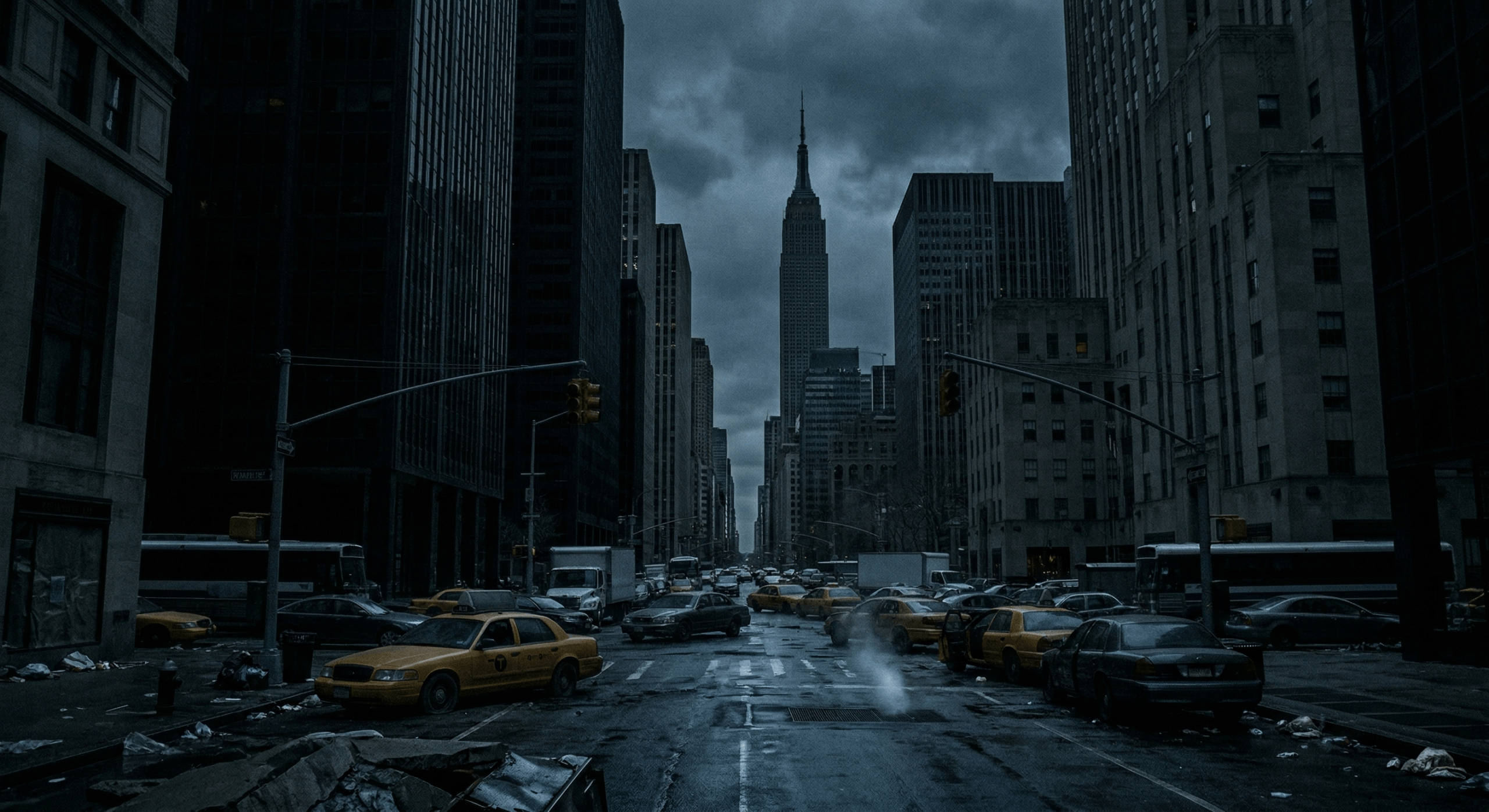
The Anatomy of a Blackout: How a Single EMP Changes Everything
It’s a Friday evening in autumn. New York City is doing what it always does at that hour. Restaurants are full. Subways are packed. Somewhere over the Hudson, the lights of Newark flicker against a sky that’s just starting to turn cold for the first time since summer.
Then at 7:03 PM everything stops.
Not in a wave. Not district by district. Everything, all at once, in an instant so complete that the city doesn’t know what to do with the silence.
That moment — the EMP blackout — is where The Severed City begins.
What the EMP Blackout Actually Does
Before I wrote a single scene, I needed to understand the physics. Not roughly. Specifically.
The Blackout is caused by a high-altitude nuclear detonation in the upper atmosphere over the Northern Hemisphere. This is not a power cut. It is not a cyberattack. Nor is it a storm. It is an electromagnetic pulse on a scale the modern world has never experienced and never truly prepared for, despite knowing for decades that it was possible. The Comprehensive Nuclear Test Ban Treaty Organization has documented the theoretical effects of such a weapon in detail.
A nuclear EMP at sufficient altitude doesn’t need to destroy buildings or kill people directly. It just needs to interact with the electrical systems that underpin every aspect of modern life. The pulse travels at the speed of light. There is no warning. One moment the grid exists. The next it doesn’t.
At the start of the story, nobody knows what caused it. The official explanation, when it eventually comes, will be a solar event. A geomagnetic storm of unprecedented scale. It takes much longer than that for the truth to surface.
What Dies First
Working through the cascade of failures system by system produces a picture bleaker than you’d first expect.
Vehicles stop where they are. Every modern engine controlled by an electronic management system cuts out instantly. The streets of Manhattan, already gridlocked on a Friday evening, become permanent gridlock within seconds. Older vehicles, those without electronic ignition, survive. They become valuable almost overnight.
Aircraft are worse. Modern fly-by-wire planes lose their electronic flight control systems all at once. Older aircraft with mechanical controls have a chance. Most in the sky that evening don’t. The approaches to JFK, LaGuardia, and Newark become catastrophic within the first hour. The fires from those crash sites burn for days, visible from across the city, with no emergency services able to reach them.
Hospitals lose backup power. Most generators are electronic systems too. The exceptions are older facilities with simpler mechanical backups, but those only run as long as their fuel holds out, with no way to resupply.
Communications go completely. Phones. Radios. The internet. Television. Gone, not disrupted. The silence that falls over eight million people in those first minutes is, by every account I’ve mapped out, the most disorienting part of the whole event.
Water pressure begins dropping within hours as the pumping stations fail. Within days it’s gone in most areas. That, more than almost anything else, is what turns a crisis into a catastrophe.
The First Hours
Most people assume it’s a power cut. An unusually large one, but New York has had blackouts before. People light candles. They go to their windows. They look out at a city darker than they have ever seen it and tell themselves someone is working on it.
That assumption holds for a few hours. Eventually it cracks.
The moment enough people understand that nothing is coming back on, that the silence from every authority is not a communications problem but an absence, is the moment the city changes. Looting starts in the areas where trust in institutions was already thin. It spreads fast. By the time dawn breaks on the first morning, New York looks and feels like a different place entirely.
Order, and the Lack of It
The police response reflects the city’s geography as much as the practical failures of the blackout. Without radios, without vehicles, without any way to coordinate, individual officers and precincts are on their own. Some areas see a visible police presence almost immediately, officers on foot working their own neighborhoods, drawing on relationships and instinct rather than procedure. Other areas see almost none.
However the military takes longer. When they arrive, filtering into the city from bases in New Jersey and upstate within a few days, they arrive without the infrastructure that makes a modern military force work. There are no communications. No air support. No coordinated command. What appears on the streets of New York in those early days is not a military response. It’s a collection of small isolated cells of soldiers doing their best in their immediate vicinity.
Kimberly’s father is among them. Although he hasn’t reached her yet.
Why This World
Every decision about how the blackout works, the physics, the cascade of failures, the fragmented human response, serves one purpose. Honesty.
Post-apocalyptic fiction has a long tradition of skipping past the details. I didn’t want to do that. I wanted a world you’d recognize as the one we actually live in, just with one catastrophic variable changed.
That’s where the real story lives. Not in the drama of the collapse itself. In what it reveals about the world that existed before it.
The blackout didn’t create the fractures. It just made them impossible to ignore.